Striscione blu con i loghi di Unione Europea, Ministero Università e Ricerca, PNRR, UniCassino, Sapienza e testo correlato.

Desiderius the Bibliophile

The numerous books that Desiderius had produced during his thirty years of rule bear witness to his ambitious cultural and artistic project.

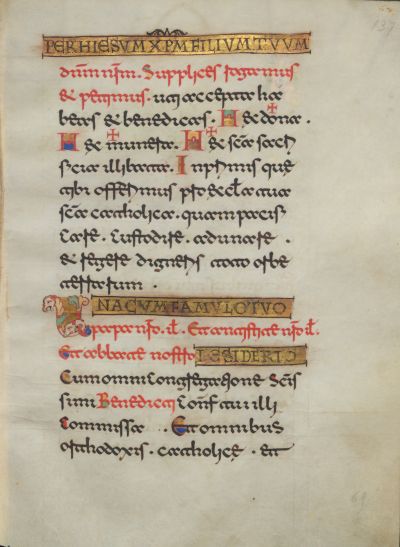
Among these, the manuscript Cod. 339, produced around 1066, stands out. The abbot’s name appears prominently on an elegant golden cartouche.

Pagina del Codice 339 con testo liturgico in scrittura medievale, caratteri in nero e rosso e iniziali ornate decorate in oro.

Cod. 339, p. 137

The decoration is sumptuous and anticipates the beauty of the codices that Desiderius had made from 1071 onwards for the consecration ceremony of the new basilica [reference to the page of the website dedicated to the subject, the virtual area] and, later on, of the other monastic buildings he had rebuilt.

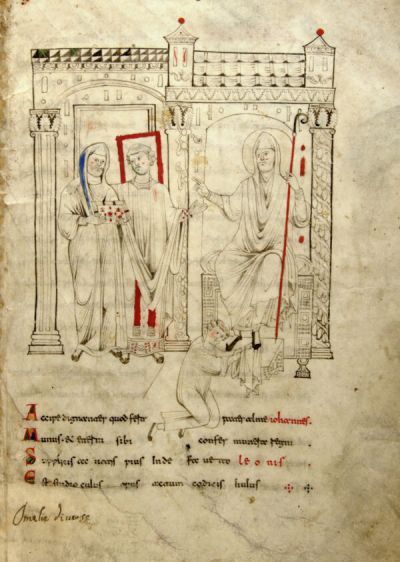
The manuscript Cod. 99 is dated 1072 and opens with a ‘Dedication Scene’ and a long subscription. The text states that, by order of Desiderius, the codex was paid for and donated to the altar of St. Benedict by Giovanni, former archpriest of the Church of Marsica, on the occasion of his monastication. Two other figures are mentioned: the supervisor and the actual creator of the book. Both were named Leone. In the image, against the backdrop of a basilica-style edifice, Desiderius presents the monk Giovanni to St. Benedict, who offers a volume closed with clasps and covered with a gem-encrusted binding.

Pagina del Codice 99 con una scena miniata: una figura seduta in trono riceve un dono da un personaggio inginocchiato, mentre due figure stanti osservano sotto un’architettura decorata.

Cod. 99, p. 3

At the saint’s feet kneels a young monk with his hands veiled in a sign of respect: this is Leone Marsicano, Giovanni’s nephew. Not only did he supervise the work, but he also became librarian and head of the scriptorium of Montecassino at Desiderius’ behest. With him, the scriptorium’s activity would experience its period of greatest splendour.

The scene and text of Cod. 99 are an important and rare testimony to the production of medieval manuscripts, because they depict all the actors and distinguish the various roles hierarchically. The recipient, St. Benedict, who receives the codex, is present; the patron, Desiderius, who commissions its execution; the donor, Giovanni, who pays for the work; the superintendent of the scriptorium, Leone, who oversees the creation of the book and is depicted smaller in size and in a humble attitude. The actual executor, i.e. the person who wrote the book, is only mentioned in passing.

Unfortunately, neither in the signature nor in the image do we find any trace of the illuminators who worked on the pages of the codex. We have no information about the adorners who created the exuberant initials, nor about the authors of the three drawings depicting the biblical episodes of the Annunciation, Joseph’s Dream, the Adoration of the Magi and the Ascension. For some unknown reason, these illuminators interrupted their work, leaving the entire upper part of the Ascension incomplete, the pages that were supposed to depict the Nativity, the Resurrection and Pentecost blank, and only small reference numbers or initials indicating colours [https://www.memo.pyle.it/strumenti/miniature-da-colorare/] that were never applied to the parchment.