


Striscione blu con i loghi di Unione Europea, Ministero Università e Ricerca, PNRR, UniCassino, Sapienza e testo correlato.

Herbariums and surgery. Medicine at Montecassino

In the Rule, St. Benedict gives instructions for the care of sick monks.

The abbot ensures that they receive the necessary care and that a suitable environment is provided. Each sick person is assisted by a monk. Sick monks are granted certain privileges: they can take therapeutic baths and, if very weak, eat meat to recover more quickly. In addition, those who are able to work are assigned less strenuous tasks.

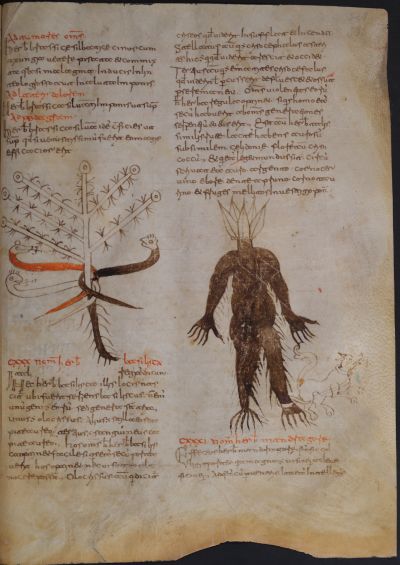
At Montecassino, interest in medicine has been documented since at least the 9th century. During this period, probably under the rule of Abbot Bertario (850-883), a valuable herbarium was created. The book describes the virtues and therapeutic uses of natural remedies. The text is accompanied by illustrations of plants and animals (Florence, Biblioteca Medicea Laurenziana, ms. Plut. 73.41 [https://tecabml.contentdm.oclc.org/customizations/global/pages/mirador-project/mirador/cdm.html?manifest=https://tecabml.contentdm.oclc.org//iiif/info/plutei/1233574/manifest.json]). The success of this type of book at Montecassino is also demonstrated by the illustrated herbarium Cod. 97, dating back to the 10th century.

Pagina miniata del Codice 97 con testi latini e figure simboliche, tra cui un albero fantastico e una creatura antropomorfa.

Cod. 97 p. 521

However, plants are not always sufficient to cure the sick. In case of need, the monks also resorted to surgery. Instruments such as the thermocautery were used. The latter has a metal tip that was heated over a flame and used for the medical practice of cauterisation. The Cassinese herbarium, now preserved in Florence, also contains drawings that show very clearly how to use it.
In the 11th century, Constantine the African arrived at Montecassino. He was a famous scientist, probably from Carthage, who, after studying in the East, became a Benedictine monk. He translated many texts from Arabic into Latin and introduced new works such as the ‘Liber Pantegni’, which brings together medical knowledge of Hellenistic and Islamic origin. The book is dedicated to Abbot Desiderius, who played a key role in promoting the study of medicine at the abbey.

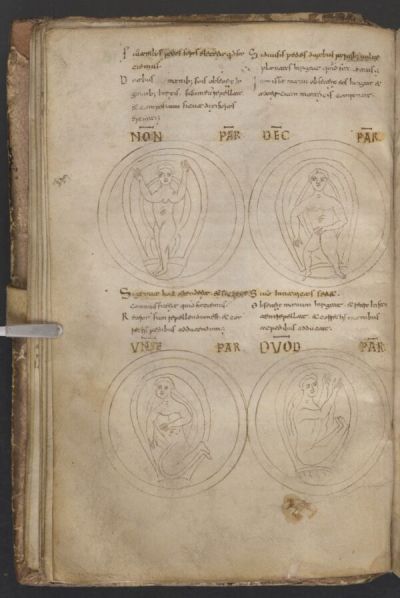
Pagina del manoscritto G.K.S. 1653 con quattro figure umane schematizzate inscritte in cerchi, accompagnate da testo latino.

Copenaghen, Det Kgl. Bibliotek, Cod. G.K.S. 1653, 4°, f. 18v

During his reign, a manuscript containing Mustione’s ‘Gynaecia’ (Copenhagen, Det Kongelige Bibliotek, ms. G.K.S. 1653, 4° [http://www5.kb.dk/manus/vmanus/2011/dec/ha/object183439/en/#kbOSD-0=page:41]), which illustrates the functioning of the female reproductive system and includes drawings of foetal positions to deal with cases of malpresentation during childbirth.