


Striscione blu con i loghi di Unione Europea, Ministero Università e Ricerca, PNRR, UniCassino, Sapienza e testo correlato.

The Desiderian Library

The lists of codes reported in the “Chronica” testify to Desiderius’ great passion for books and the richness of the monastery library during his reign. Between 1058 and 1087, approximately 85 volumes are listed. This is an impressive number, to which must be added other codices that are not recorded by Leone Ostiense. These are books produced in the monastery, or donated or purchased.

Most of the volumes have survived over the centuries and are preserved in the Abbey Archives. Others have been dispersed to other locations. Taken as a whole, they allow us to reconstruct the book collection of Desiderius’ era.

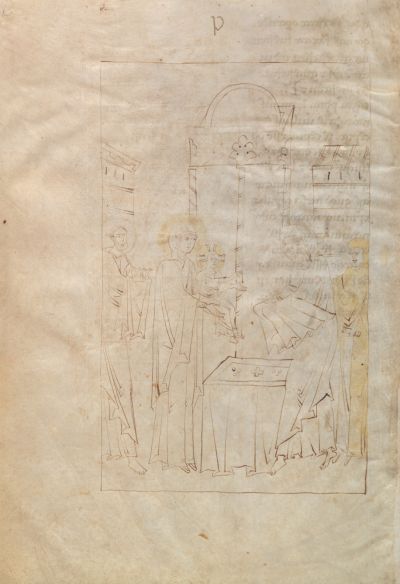
Pagina del Codice 98 con una scena miniata tracciata a linee: la Vergine con il Bambino al centro, affiancata da figure aureolate sotto un’architettura stilizzata.

Cod. 98 p. 6

This consisted mainly of religious texts. The manuscripts intended for liturgy are the most splendid.

Two examples are Cod. 98 [https://omnes.dbseret.com/montecassino/view.jsp?cid=IT-FR0084_0098] and Cod. 99, which contain the homilies to be read on the feast days of the Virgin and the Baptist, Christmas, St Stephen, St John the Evangelist, Epiphany, Easter, Ascension and Pentecost. Then there is Cod. 339 [https://omnes.dbseret.com/montecassino/view.jsp?cid=IT-FR0084_0339], a Sacramentary that the celebrant used to read the various prayers during Mass. The Lectionary Vat. Lat. 1202 [https://digi.vatlib.it/view/MSS_Vat.lat.1202], on the other hand, was used during the night offices of the vigils and feasts of St. Benedict, St. Maurus and St. Scholastica. Finally, there are the Exultets [internal link to the website, to the virtual area with the pulpit], which the deacon unrolled from the pulpit during the Easter Vigil on Holy Saturday, incanting the prayer announcing the Resurrection of Christ to the faithful.
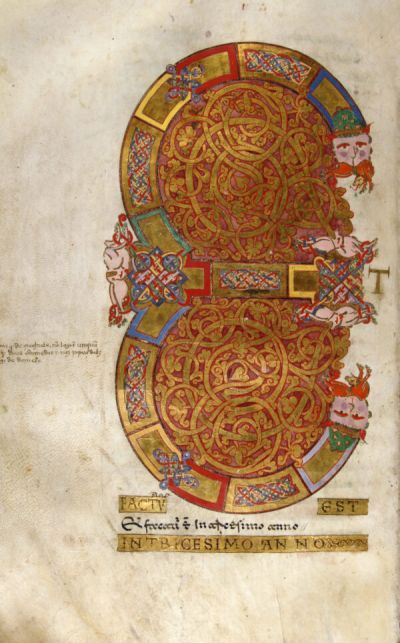
Pagina del Codice 571 con una grande iniziale decorata in oro e colori vivaci, composta da intrecci geometrici e figure zoomorfe stilizzate.

Cod. 571 p. 332

Bibles were also copied, such as Cod. 520 and Cod. 571, as well as the works of the Church Fathers, especially Augustine, such as Cod. 14. There were also books dedicated to study: texts on history, geography and topography, such as Cod. 391. Additionally, there were classical works, such as those of Aristotle, contained in Vat. Ottob. Lat. 1406, legal treatises such as the book of Decretals, Cod. 1, and texts on the liberal arts such as the mathematics book Cod. 189 [internal reference to the website, Category 5, Article 3] or Cod. 318 [internal reference to the website, Category 5, Article 4], with musical content.