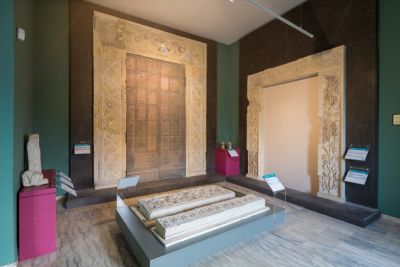
The history of Montecassino Abbey began around 529, with the arrival of St. Benedict, who left Subiaco in search of a place to settle with his monks. The first community settled among the ruins of the ancient acropolis of the Roman city of ‘Casinum’, where an oratory dedicated to St Martin and a church for St John the Baptist were built. Here, Benedict wrote his ‘Rule’, a set of directives for monastic life, and died in around 547.
Thirty years later, in 577, the Lombards, who were advancing to conquer southern Italy, destroyed the Abbey. The monks probably took refuge in Rome. Reconstruction began in 717 under Abbot Petronace. In the 8th and 9th centuries, the number of monks increased and the Abbey strengthened its political role. In 744, the Duke of Benevento, Gisulfo II, donated extensive surrounding territories to the monastery, laying the foundations for the creation of the Land of St. Benedict (‘Terra Sancti Benedicti’), over which the abbot gained full power.