Striscione blu con i loghi di Unione Europea, Ministero Università e Ricerca, PNRR, UniCassino, Sapienza e testo correlato.

The harmony of numbers

Medieval culture considered music to be a science of numbers, closely linked to mathematics and geometry.  It was based on the concept of harmony as a reflection of cosmic order and laws. The philosopher Boethius, in his treatise ‘De institutione musica’, the most widely read work on music in the Middle Ages, assigned special importance to music because it was the only discipline of the quadrivium capable of directly influencing the human soul through hearing. Singing played a fundamental role in the liturgy and was therefore one of the main activities associated with monastic life.

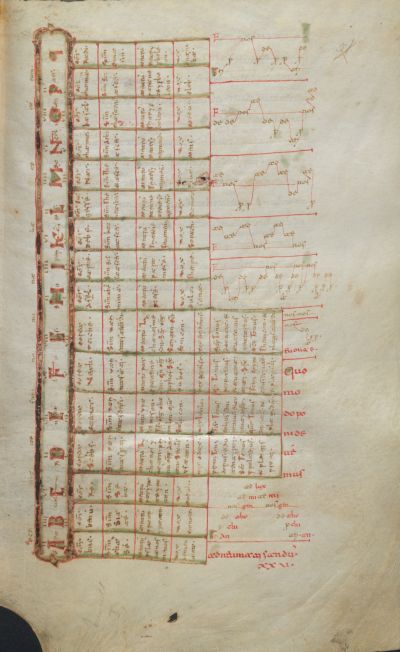
Pagina del Codice 318 con una tabella medievale a colonne e righe, decorata in rosso e verde, accompagnata da annotazioni latine.

Cod. 318, p. 51

Evidence of the importance given to music and singing at Montecassino can be found in Cod. 318 [https://omnes.dbseret.com/montecassino/view.jsp?cid=IT-FR0084_0318], which can be dated to the end of the 11th century. It contains a collection of musical texts from various periods, up to the most recent ‘Micrologus’ by Maestro Guido d’Arezzo (c. 992 – 1050). The latter devised a revolutionary teaching method based on the hexachord, i.e. solmisation syllables and notation, which laid the foundations for the modern musical system.

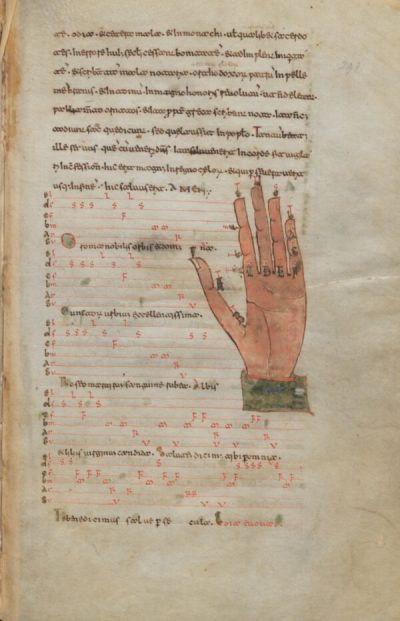
The book, characterised by a rich array of decorated initials that also serve to facilitate reading and consultation, presents images and examples of music theory, such as the alphabetical notation letter scheme. Of particular importance is the so-called Guidonian hand, the oldest representation of its kind that has survived to this day. It serves to facilitate memorisation: the letters on each finger allow students to remember the scales and intervals between notes, while teachers can use it to easily indicate the tone of songs to their pupils.

Pagina del Codice 318 con testo latino e una mano miniata usata come guida mnemonica per l’intonazione, con lettere e segni musicali annotati sulle dita.

Cod. 318, p. 291