Striscione blu con i loghi di Unione Europea, Ministero Università e Ricerca, PNRR, UniCassino, Sapienza e testo correlato.

The art of counting

The monks’ studies in the monastery also included in-depth study of the liberal arts of the quadrivium, namely arithmetic and geometry, music and astronomy. These studies served not only to learn about the world, but also provided  a means of helping monks to overcome the limitations of the senses and arrive at a deeper understanding of reality.

Mathematics, in particular, which had long been neglected, re-emerged in the Middle Ages.

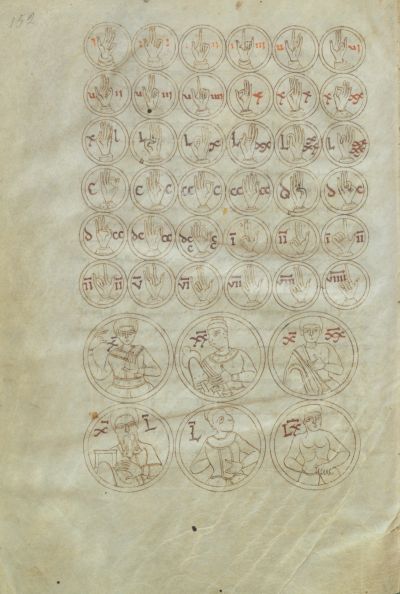
Among the manuscripts preserved at Montecassino, Cod. 189 occupies a significant place. It is a study book that collects texts on mathematics and calculation for school use, such as Boethius’ De institutione arithmetica, Gerbert of Aurillac’s Regulae de numerorum abaci rationibus, various passages from Isidore’s Etymologies, and the first chapter of Bede’s De temporum ratione.

Pagina del Codice 189 con una serie di cerchi contenenti gesti della mano e figure umane, utilizzati come sistema visivo di notazione e classificazione.

Cod. 189, p. 152


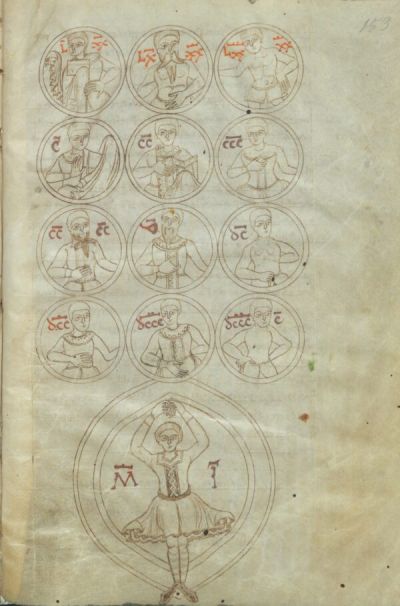
The history of the book is linked to Pandolfo da Capua, a mathematician and author of a treatise entitled ‘De calculatione’, who joined the Cassinese community around 1065. The manuscript features two pages depicting the digital computing system known as ‘indigitatio’. This ingenious calculation system allowed counting from one to one million by bending the fingers, gesturing with the arms and hands and associating them with other parts of the body. Thirty-six medallions therefore depict hands with fingers bent in various ways to count numbers up to 10,000, while for numbers up to 900,000, the numbers are represented by half-length figures placing their hands on their chest, navel, thigh or hip, with their palms facing outwards or inwards.  Finally, the number one million is depicted by the full figure of a man raising his arms above his head with his fingers intertwined.

Pagina del Codice 189 con figure umane inscritte in cerchi, ciascuna con gesti e posture differenti, e una grande figura centrale in posizione danzante entro una cornice circolare.

Cod. 189, p. 153